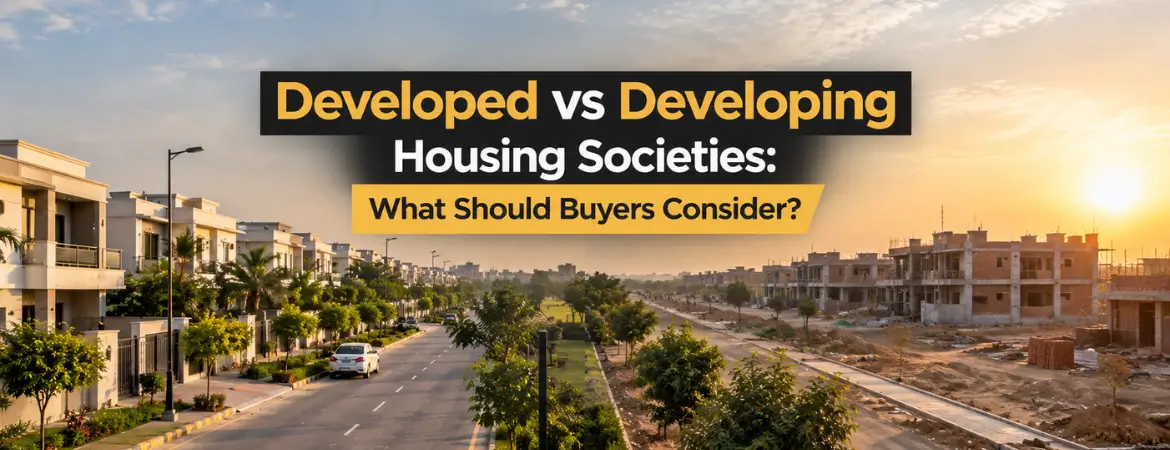
When searching for a residential plot in Lahore, buyers often face a choice between a developed housing society and one that is still developing. Both can offer opportunities, but the right choice depends on the buyer’s budget, timeline, intended use and expectations.
A developed community may offer existing infrastructure, occupied homes and accessible amenities, while a developing society may appeal to buyers who are willing to wait for future development and growth.
So, which option makes more sense?
The answer is not simply about finding the lowest-priced plot. Buyers should understand what is already available, what they may have to wait for and how the development stage fits their property goals.
What is a Developed Housing Society?
A developed housing society is an established residential community where major infrastructure, roads, utilities and essential amenities are already available or operational. Existing homes and residents can also give buyers a clearer understanding of the community’s actual environment.
For someone planning to construct a home in the near future, this can make the buying decision easier. Instead of relying mainly on future development plans, buyers can visit the location and evaluate the surroundings themselves.
They can observe roads, houses, parks, security arrangements, commercial activity and access to nearby facilities before making a decision.
In simple terms, a developed society gives buyers a better opportunity to assess what exists today.
What is a Developing Housing Society?
A developing housing society is still going through different stages of infrastructure and community development. Roads, utilities, parks, commercial areas and residential blocks may be under construction or planned for future phases.
These communities can attract buyers who are comfortable with a longer timeline and want to participate at an earlier stage of development.
However, buyers should understand that future development involves waiting and uncertainty. The actual timeline for different facilities can vary, and the residential environment may take time to become established.
This does not mean that developing societies are automatically a poor choice.
Rather, they are suited to buyers whose investment goals and timelines allow them to wait for the community to mature.
The Real Question: What Are You Buying Today?
Property buyers should look beyond the advertised price and consider what is already available within the community.
Roads, utilities, security, parks, commercial facilities, surrounding houses and accessibility can all influence the practical value of a residential plot.
A developing society may have attractive future plans, but a buyer should understand how much of that plan has already become reality.
A developed society provides a different advantage: the buyer can physically observe the existing environment.
This leads to an important question:
Are you buying a property for what it is today, or primarily for what you expect it to become in the future?
The answer can help determine which development stage is more suitable for you.
Developed vs Developing: What Do You Get Today?
The biggest difference between developed and developing housing societies is the level of existing infrastructure and community activity.
In a developed community, buyers can usually evaluate the surroundings more directly. Existing roads, homes, parks, utilities and other facilities provide visible evidence of the area’s development.
In a developing community, buyers may need to assess construction progress, development plans and the expected timeline for future facilities.
Neither approach is automatically right for every buyer.
The important thing is to match the development stage with your own requirements instead of choosing a property simply because its initial price appears attractive.
Is a Lower Price Worth Waiting for Development?
Price is naturally one of the biggest considerations when purchasing property.
A developing society may offer an attractive entry point, but buyers should also consider the cost of waiting.
If roads, utilities, commercial activity and surrounding homes are still developing, the buyer may need to wait before enjoying the full residential environment they expect.
That waiting period can matter to someone who wants to construct a house soon.
For a long-term investor who is comfortable holding property while an area develops, the timeline may be less important.
The key is to understand the trade-off.
A lower initial price may come with a longer waiting period, while a developed property may provide greater visibility into the community and its existing infrastructure.
Therefore, the decision should not be based on price alone.
Why Infrastructure Matters When Choosing a Housing Society?
Infrastructure can significantly influence the convenience and usability of a residential community.
Roads, electricity, water, drainage, security, green spaces and access to everyday facilities all contribute to the living experience.
Connectivity is equally important.
A housing society may offer attractive internal facilities, but its connection to major roads and important parts of the city can influence daily travel for residents.
For families, this may affect journeys to schools, workplaces, hospitals, markets and other essential destinations.
This is why buyers should evaluate the housing society as a complete community, rather than looking only at the plot itself.
What Makes an Established Community Different?
One of the clearest ways to understand a housing society is to look at its existing community.
Occupied homes, ongoing construction, local businesses and everyday activity can give buyers a better understanding of how the area is functioning.
For families planning to move into a community, this can be especially important.
A developing society may eventually reach the same level of activity, but buyers may need to wait for population, businesses and facilities to grow.
An established community allows buyers to evaluate the current residential environment before committing to construction.
What About Families Looking for a Place to Live?
For homebuyers, the surrounding environment can be just as important as the plot itself.
Families may look for parks, schools, mosques, markets, security and accessible roads. They may also prefer an area where other families are already living because an occupied community provides a clearer picture of everyday residential life.
A developing society may eventually provide these features, but the buyer may have to wait.
A developed society offers the opportunity to inspect many of these factors before purchasing.
This is particularly relevant for buyers considering smaller residential plots such as 3 Marla or 5 Marla, where affordability, construction requirements and practical family living can all influence the decision.
Eastern Housing Lahore: A Developed Community for Buyers to Evaluate
Eastern Housing Lahore reflects the developed-community approach for buyers looking for an established residential environment in Lahore.
Baber and Mughal Blocks are developed, with more than 300 families already living in the community and additional houses under construction. Eastern Housing Lahore also offers 3 and 5 Marla residential plots.
The community is located near the Quaid-e-Azam Interchange on Lahore Ring Road, with access to major routes and nearby destinations. The official project information highlights connectivity to the Orange Line and Allama Iqbal International Airport, along with other nearby facilities.
For buyers considering on-ground plots for sale in Lahore, this type of development allows them to evaluate an actual residential environment rather than relying entirely on future development plans.
Eastern Housing Lahore provides developed roads, landscaped parks, a mosque, an outdoor gym, security infrastructure and other community facilities.
The objective is not simply to offer a plot, but to provide buyers with a residential environment that they can assess based on its existing development and community activity.
Why 3 Marla and 5 Marla Plots Can Be Practical Options?
Plot size is another factor buyers should consider alongside the development stage of a housing society.
A 3 Marla plot may suit buyers looking for a more compact residential option or working within a tighter budget. A 5 Marla plot provides additional space and may be more appropriate for families with larger space requirements.
The right choice depends on the buyer’s construction plan, family size, financial capacity and intended use of the property.
Eastern Housing Lahore offers 3 and 5 Marla residential plot options, giving buyers different choices within the community.
Rather than selecting a plot size simply because it appears affordable, buyers should consider the total cost of construction and how the property will be used over the long term.
Why Visiting the Location Matters?
Online listings, advertisements and property discussions can provide useful information, but they should not replace physical evaluation.
Whenever possible, buyers should visit the location themselves and observe the roads, surrounding development, houses, amenities and overall environment.
A site visit can help answer practical questions that may not be obvious from photographs or promotional material.
For example, buyers can assess how accessible the location feels, how developed the surrounding streets are and whether the existing community matches their expectations.
This is particularly important when comparing a developed society with a developing one.
What Should Buyers Verify Before Buying a Plot?
Whether you choose a developed or developing housing society, proper due diligence remains essential.
First, verify the development status rather than relying only on promotional claims. Look at the actual site and understand which facilities are operational and which are still planned.
Location and accessibility should also be evaluated carefully. Consider the routes you would use for work, education, healthcare, shopping and other regular activities.
Buyers should also independently review relevant documentation, ownership or allocation details, approval status, payment terms, transfer conditions, possession arrangements and applicable development charges.
It is also important to understand exactly what is included in the purchase and what additional costs may apply.
The objective is simple: understand what you are buying today and what you are being told to expect in the future.
Developed or Developing: Which Should You Choose?
The better option depends on your objective.
If your priority is existing infrastructure, visible development, community activity and a clearer picture of residential living, a developed housing society may be more suitable.
If your priority is long-term growth and you are comfortable with a longer development timeline, a developing society may deserve consideration.
Neither option should be judged purely by price.
A lower-priced property may require more patience, while a developed property may provide greater visibility into the actual environment and infrastructure.
The smartest approach is to consider your timeline, budget, intended use, location preferences and tolerance for uncertainty before making a decision.
Final Thoughts
Choosing between a developed and developing housing society is ultimately a decision between different stages of opportunity.
A developing community may offer the potential associated with future growth, but buyers need to consider the waiting period and development uncertainty. A developed community provides greater visibility, existing infrastructure and a clearer picture of the residential environment.
For buyers considering residential plots, especially those planning to construct a home rather than simply hold land for an uncertain period, the development status of the surrounding community deserves serious attention.
Eastern Housing Lahore demonstrates why this factor can matter. With developed residential blocks, an existing community, infrastructure, community amenities and 3 and 5 Marla residential plot options, buyers can evaluate the project based on its present environment as well as their own future requirements.
Ultimately, the right housing society is the one that aligns with your budget, intended use, investment horizon and expectations for development.
Buyers should evaluate what is available today, understand what is planned for the future and verify the relevant property details before making a commitment.
For those who prioritize an established residential environment and want to assess the development for themselves, visiting the community and reviewing the available residential plot options can be a practical next step.
FAQs
Are developed housing societies better for families?
Developed societies can be more suitable for families who prioritize existing infrastructure, accessibility, amenities and an established residential environment. However, buyers should still evaluate the specific society and its facilities before making a decision.
Are developing housing societies better for investment?
A developing society may appeal to buyers with a longer investment horizon, but the decision should be based on factors such as location, development progress, documentation, approvals and the buyer’s willingness to wait.
What should I check before buying a plot in a housing society?
Buyers should review the development status, location, documentation, relevant approvals, utilities, possession arrangements, payment terms, transfer process and any applicable additional charges.
Why consider an on-ground residential plot?
An on-ground plot can allow buyers to evaluate a specific physical location and its surrounding environment. This can be particularly useful for buyers who want to understand the actual development before purchasing.
 Skip to content